

Icons of Opium Exhibit (Kosovo)
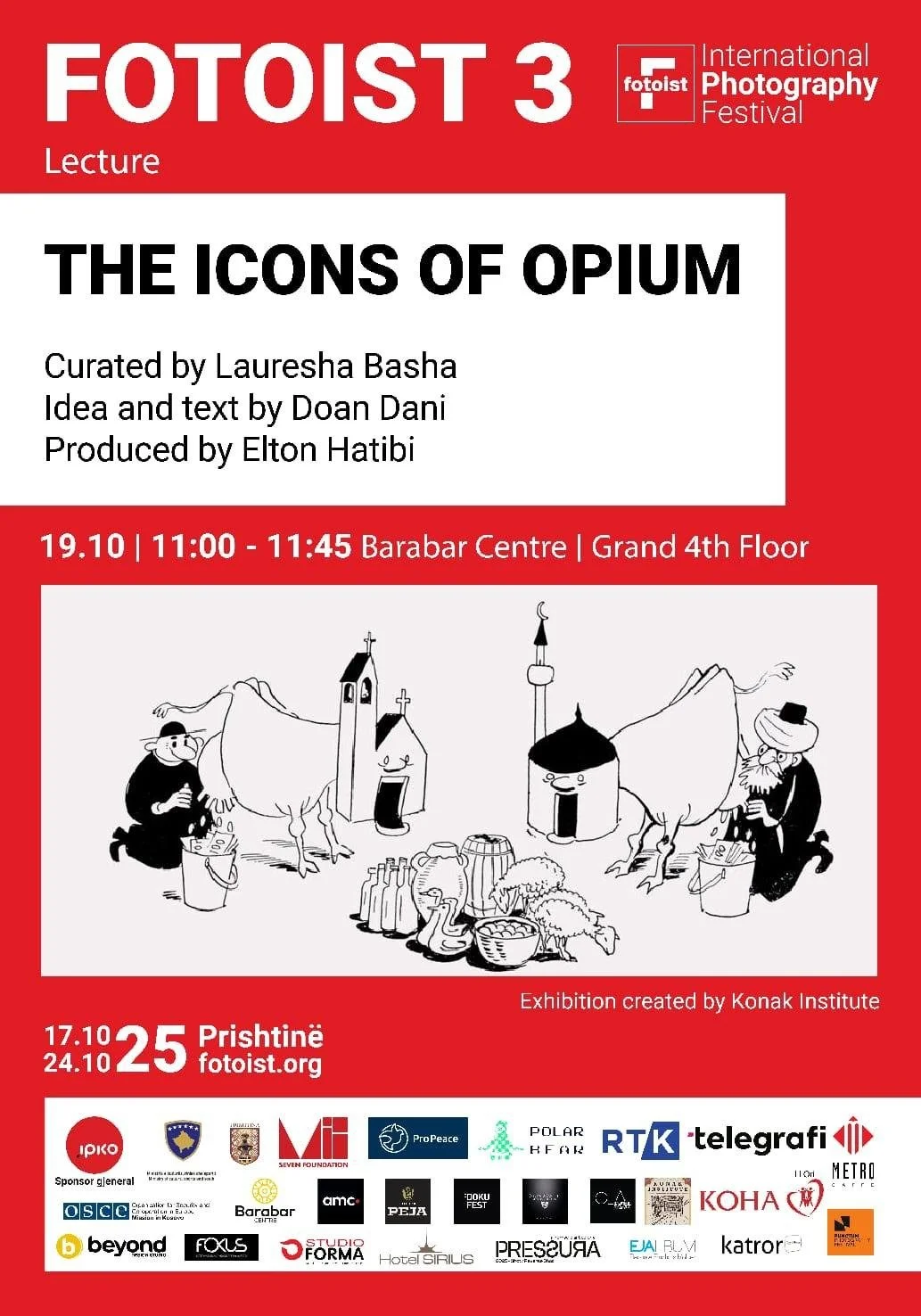
The Icons of Opium exhibition, hosted at Kalo Gallery from April 4 to 11, 2025, presented a critical visual archive of anti religious propaganda produced under Albania’s communist regime between 1946 and 1967. Curated by Doan Dani and Lauresha Basha, the exhibition assembled archival posters, satirical cartoons, and state periodicals that formed part of a systematic ideological campaign aimed at delegitimizing religion prior to and following the formal prohibition of religious practice.
The works on display demonstrate how faith was portrayed as a mechanism of corruption and social control. Believers were routinely caricatured as intellectually deficient, blind followers manipulated by clerical authority, and obstacles to socialist progress. These visual tropes were not incidental artistic expressions; they were components of a coordinated propaganda apparatus designed to erode the moral and social credibility of religious communities before the state imposed its total religious ban.
Spanning material from the immediate post war period beginning in 1945 through the consolidation of the ban in 1967, the exhibition traced the gradual intensification of anti religious rhetoric. The iconography reveals clear transnational influences, particularly from the visual languages of Soviet and Chinese communist propaganda, which similarly framed religion as superstition, backwardness, and ideological deviation. Stylized depictions of clergy as parasitic figures, exaggerated imagery of ritual as irrational spectacle, and slogans equating faith with ignorance demonstrate a shared aesthetic and ideological grammar across these regimes.
The materials were retrieved through the dedicated archival research of Doan Dani, research fellow at the University of Montreal, with the support of Elton Hatibi, resident fellow at the Konak Institute. Their work ensured that these artifacts, once instruments of repression, could be recontextualized as historical evidence rather than instruments of erasure.
By foregrounding these images in a public forum, Icons of Opium invited reflection on collective memory, repression, and resilience. The exhibition did not merely display propaganda; it examined the mechanisms by which a state sought to delegitimize faith, reshape cultural consciousness, and redefine moral authority. In doing so, it opened space for a renewed conversation about the endurance of religious life in Albania despite sustained attempts at ideological eradication, and it received significant national media coverage while prompting broad cultural commentary.
Saraje - Museum Workshop (Albania)
The Islamic Art Museum (I AM), to be established in the historic Saraje Building in the heart of Tirana, is envisioned as a flagship institution dedicated to safeguarding, studying, and presenting Islamic material and intellectual heritage in Albania and the wider Mediterranean world. Designed as both a research center and public museum, the project seeks to connect historical craftsmanship, manuscript culture, and devotional arts with contemporary curatorial practice and public learning.
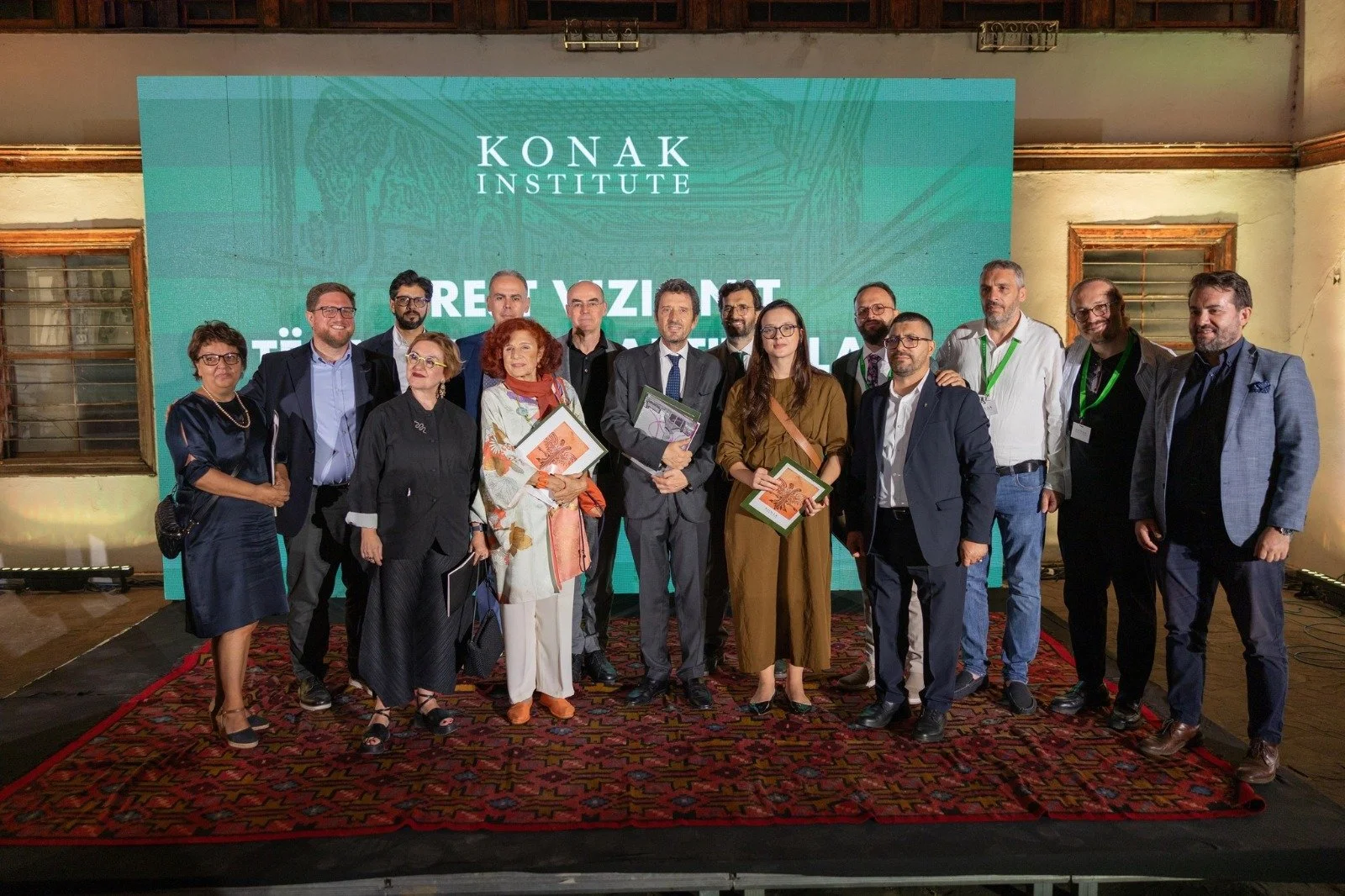
A decisive milestone occurred on 17 September 2025 at the International Workshop organized by the Konak Institute. On this occasion, Edi Rama publicly announced that the Sarajet building will serve as the permanent site of the future Museum of Islamic Art and formally affirmed the Government’s cooperation with the Konak Institute in its establishment. The Prime Minister’s presence and endorsement elevated the project to the level of national cultural commitment, affirming that Islamic heritage constitutes an integral dimension of Albania’s historical and civic identity.
The workshop convened a distinguished and internationally recognized assembly. Among those in attendance were Blendi Gonxhe; Princess Vittoria Alliata di Villafranca, noted Italian publisher and cultural figure; Pietrangelo Buttafuoco, Director of the Venice Biennale; Dr. Bilal Badat, an internationally prominent curator of Islamic art; Prof. Ardian Isufi and Prof. Edison Ceraj of the Academy of Arts in Tirana, both leading voices in Albanian contemporary art and theory; Dr. Doan Dani, historian and research fellow at the University of Montreal; Besnik Sinani, Director of the Konak Institute and Lecturer at the University of Tübingen; and Imam Saimir Ismaili, collector and steward of the emerging museum collection. The session was moderated by architect Mimi Kotorri, a specialist closely engaged with the museum’s architectural and conceptual development.
The architectural vision was presented by Rotterdam based architect Jesús Hernández, proposing a sensitive restoration of the historic Sarajet structure alongside a purpose built adjacent facility. The design integrates conservation ethics with contemporary museological standards, incorporating archival storage, research spaces, conference facilities, and galleries for rotating exhibitions. Conceived as an open and accessible campus, the ensemble aligns with international benchmarks for preservation, education, and public engagement.
The breadth of attendance, spanning state leadership, international cultural figures, curators, scholars, artists, and religious representatives, underscored the project’s interdisciplinary and transnational significance. The workshop did not merely outline a building project; it articulated a coordinated cultural vision in which Albania’s Islamic artistic heritage is preserved, critically studied, and institutionally anchored for future generations.
Icons of Opium Exhibit (Albania)
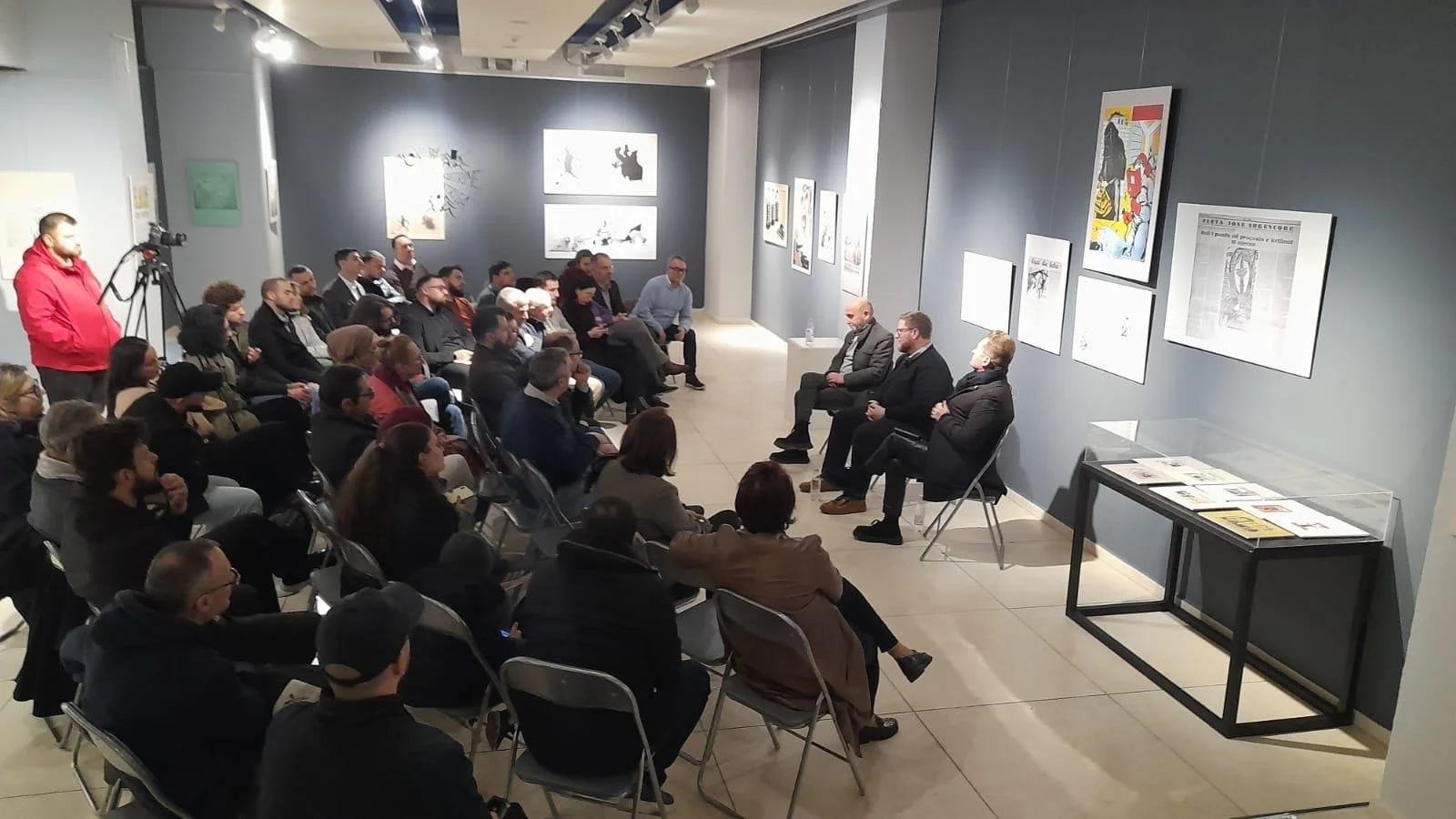
The Icons of Opium exhibition, hosted at Kalo Gallery from April 4 to 11, 2025, presented a critical visual archive of anti religious propaganda produced under Albania’s communist regime between 1946 and 1967. Curated by Doan Dani and Lauresha Basha, the exhibition assembled archival posters, satirical cartoons, and state periodicals that formed part of a systematic ideological campaign aimed at delegitimizing religion prior to and following the formal prohibition of religious practice.
The works on display demonstrate how faith was portrayed as a mechanism of corruption and social control. Believers were routinely caricatured as intellectually deficient, blind followers manipulated by clerical authority, and obstacles to socialist progress. These visual tropes were not incidental artistic expressions; they were components of a coordinated propaganda apparatus designed to erode the moral and social credibility of religious communities before the state imposed its total religious ban.
Spanning material from the immediate post war period beginning in 1945 through the consolidation of the ban in 1967, the exhibition traced the gradual intensification of anti religious rhetoric. The iconography reveals clear transnational influences, particularly from the visual languages of Soviet and Chinese communist propaganda, which similarly framed religion as superstition, backwardness, and ideological deviation. Stylized depictions of clergy as parasitic figures, exaggerated imagery of ritual as irrational spectacle, and slogans equating faith with ignorance demonstrate a shared aesthetic and ideological grammar across these regimes.
The materials were retrieved through the dedicated archival research of Doan Dani, research fellow at the University of Montreal, with the support of Elton Hatibi, resident fellow at the Konak Institute. Their work ensured that these artifacts, once instruments of repression, could be recontextualized as historical evidence rather than instruments of erasure.
By foregrounding these images in a public forum, Icons of Opium invited reflection on collective memory, repression, and resilience. The exhibition did not merely display propaganda; it examined the mechanisms by which a state sought to delegitimize faith, reshape cultural consciousness, and redefine moral authority. In doing so, it opened space for a renewed conversation about the endurance of religious life in Albania despite sustained attempts at ideological eradication, and it received significant national media coverage while prompting broad cultural commentary.
The Paths of Letters Exhibit (Albania)
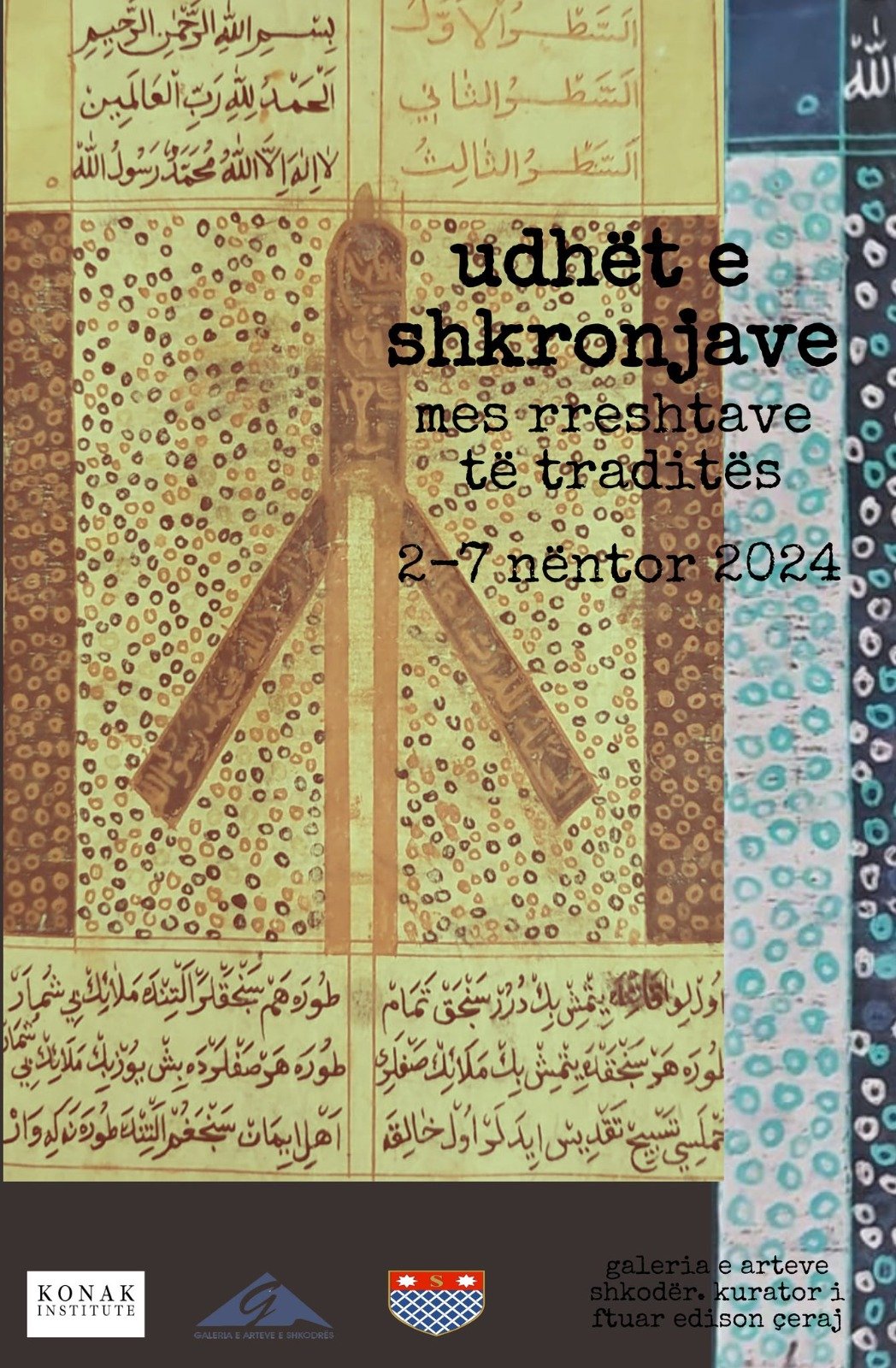
Udhët e Shkronjave (“The Paths of Letters”) was presented in November 2024 at the City Gallery in Shkodër, curated by Elton Hatibi and Edison Ceraj with coordination by Fisnik Barbullushi. The exhibition assembled manuscripts, calligraphic works, and religious texts originating exclusively from Shkodër, long regarded as one of the most important historical centers of Albanian civic life and Islamic scholarship.
The title itself suggested both movement and transmission: letters travel across generations, geographies, and intellectual lineages. By foregrounding the written word, the exhibition highlighted Shkodër’s historic role as a locus of literary cultivation, theological study, and mystical reflection. The displayed artifacts spanned multiple centuries, offering a layered view of the region’s scholarly continuity. Among the most significant works were medieval Qurʾānic manuscripts, whose artistic features and material composition testify to the presence of refined scribal cultures embedded within the city’s religious institutions.
These materials challenge reductive narratives that marginalize Islamic intellectual life in the Balkans. Instead, they reveal a sustained engagement with Qurʾānic exegesis, devotional practice, and manuscript production that situated Shkodër within broader Ottoman and transregional networks of learning. The exhibition emphasized that Islamic scholarship in Albania was not peripheral but structurally integrated into the intellectual currents of its time.
Importantly, the works presented form part of the broader and growing collection envisioned for the future Museum of Islamic Art, a flagship initiative of the Konak Institute. Their inclusion in the Shkodër exhibition marked both a homecoming and a curatorial statement: that local heritage must be preserved, studied, and reintroduced into public consciousness through rigorous institutional stewardship.
By situating these artifacts within a contemporary gallery setting, Udhët e Shkronjave transformed manuscripts from archival remnants into active interlocutors in present day cultural discourse. The exhibition offered visitors not only aesthetic appreciation, but also a reorientation toward Shkodër’s intellectual and spiritual legacy, reaffirming the city’s historical stature as a center of learning whose letters continue to trace living paths across time.
Prof. Jonathan Brown Book Tour Part 2 (Kosovo)
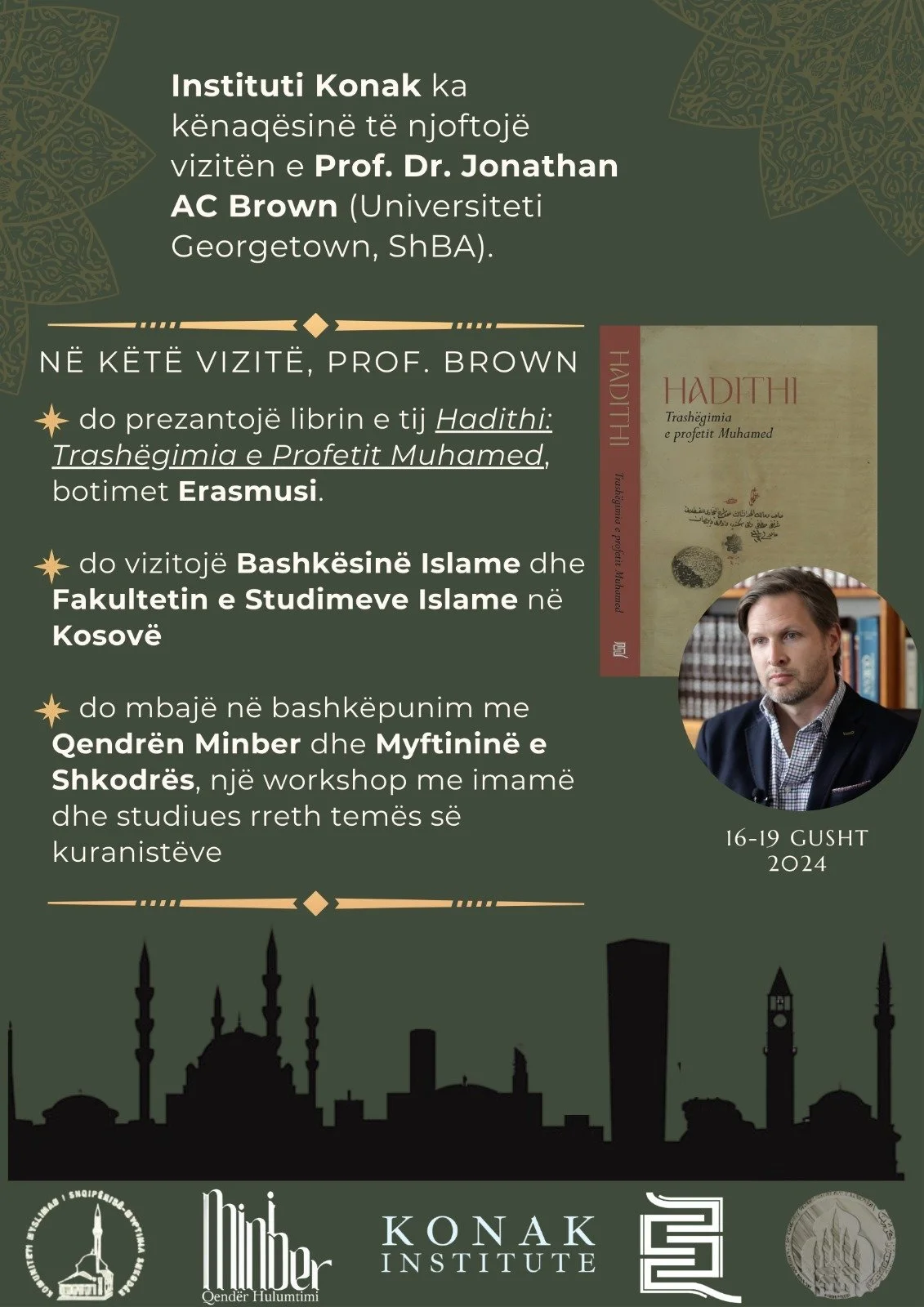
The Konak Institute is hosting Jonathan A. C. Brown, Professor of Islamic Civilization at Georgetown University and one of the foremost contemporary authorities on the ḥadīth tradition in Western academia. Trained in both the classical Islamic sciences and modern critical historiography, Brown’s scholarship bridges traditional learning and western, university based research, offering a rigorous synthesis of traditional Sunni legal theory, theology, and contemporary academic methods. His work has become central to understanding how Prophetic traditions were transmitted, authenticated, canonized, and interpreted across centuries of Muslim intellectual history.
The Albanian edition of Hadith: Muhammad's Legacy in the Medieval and Modern World was translated and published by Erasmus, whose editorial initiative made this foundational study accessible to Albanian readers. As a partner institution, the Konak Institute collaborated closely in supporting the public reception of the text, hosting its presentation and facilitating scholarly engagement around its themes. The translation itself reflects Erasmus’s substantive commitment to producing academically reliable editions that meet both linguistic precision and intellectual integrity, thereby contributing directly to the strengthening of Islamic studies literature in the Albanian language.
Brown’s study offers a systematic account of the development of ḥadīth sciences, examining isnād criticism, narrator evaluation, the formation of canonical collections, and the epistemological debates that shaped Sunni orthodoxy. He demonstrates that the preservation of the Prophet’s legacy was the result of disciplined scholarly procedures and sustained internal critique, rather than static transmission. By situating contemporary disputes within this long historical arc, he reframes modern anxieties about authenticity, reform, and authority as questions that have always been negotiated within the Islamic scholarly tradition itself.
For Muslim communities navigating contemporary challenges related to scriptural interpretation and religious authority, the availability of this work in Albanian constitutes an important intellectual resource. It equips readers with a historically grounded understanding of how ḥadīth functioned as a living and self regulating tradition, while clarifying the methodological distinctions between classical scholarship and modern ideological appropriations. In supporting the public introduction of this publication, the Konak Institute contributed to fostering a culture of textual literacy and disciplined engagement, while Erasmus’s independent translation and publishing effort ensured that this foundational study now stands as a durable part of the Albanian Islamic intellectual landscape.
Prof. Jonathan Brown Book Tour Part 1 (Albania)
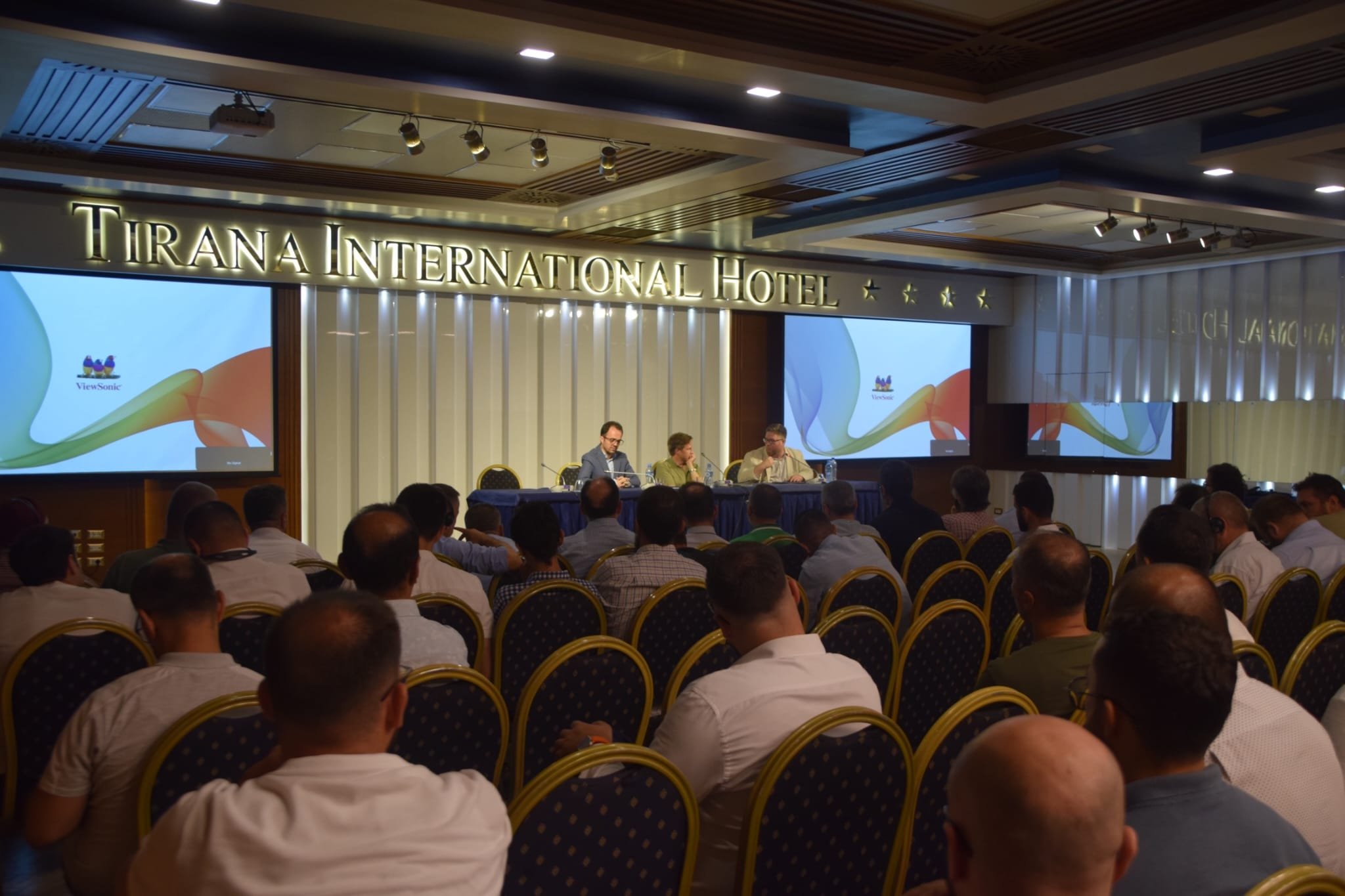
The Konak Institute is hosting Jonathan A. C. Brown, Professor of Islamic Civilization at Georgetown University and one of the foremost contemporary authorities on the ḥadīth tradition in Western academia. Trained in both the classical Islamic sciences and modern critical historiography, Brown’s scholarship bridges traditional learning and western, university based research, offering a rigorous synthesis of traditional Sunni legal theory, theology, and contemporary academic methods. His work has become central to understanding how Prophetic traditions were transmitted, authenticated, canonized, and interpreted across centuries of Muslim intellectual history.
The Albanian edition of Hadith: Muhammad's Legacy in the Medieval and Modern World was translated and published by Erasmus, whose editorial initiative made this foundational study accessible to Albanian readers. As a partner institution, the Konak Institute collaborated closely in supporting the public reception of the text, hosting its presentation and facilitating scholarly engagement around its themes. The translation itself reflects Erasmus’s substantive commitment to producing academically reliable editions that meet both linguistic precision and intellectual integrity, thereby contributing directly to the strengthening of Islamic studies literature in the Albanian language.
Brown’s study offers a systematic account of the development of ḥadīth sciences, examining isnād criticism, narrator evaluation, the formation of canonical collections, and the epistemological debates that shaped Sunni orthodoxy. He demonstrates that the preservation of the Prophet’s legacy was the result of disciplined scholarly procedures and sustained internal critique, rather than static transmission. By situating contemporary disputes within this long historical arc, he reframes modern anxieties about authenticity, reform, and authority as questions that have always been negotiated within the Islamic scholarly tradition itself.
For Muslim communities navigating contemporary challenges related to scriptural interpretation and religious authority, the availability of this work in Albanian constitutes an important intellectual resource. It equips readers with a historically grounded understanding of how ḥadīth functioned as a living and self regulating tradition, while clarifying the methodological distinctions between classical scholarship and modern ideological appropriations. In supporting the public introduction of this publication, the Konak Institute contributed to fostering a culture of textual literacy and disciplined engagement, while Erasmus’s independent translation and publishing effort ensured that this foundational study now stands as a durable part of the Albanian Islamic intellectual landscape.
Language as Lived Experience (Albania)
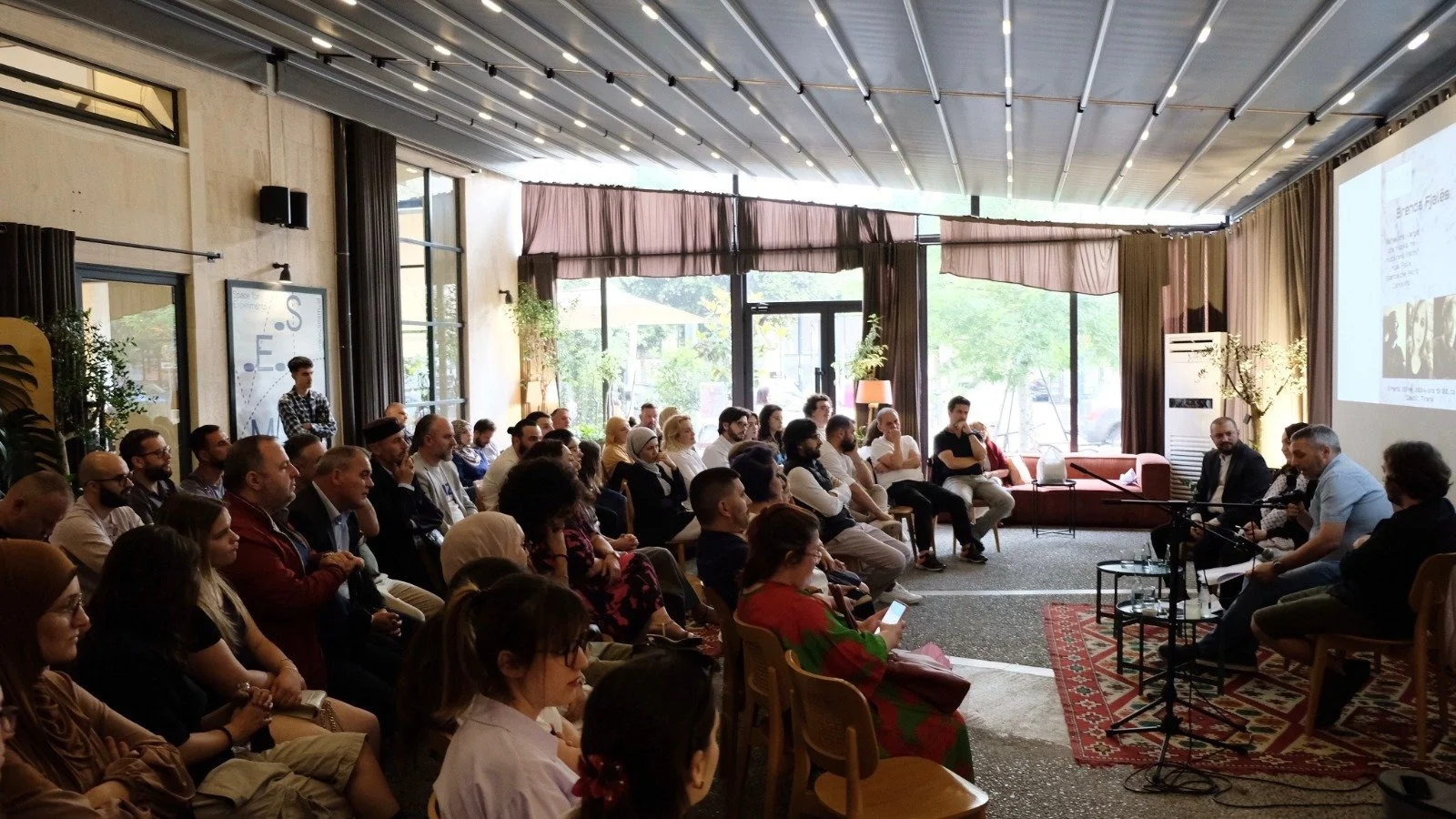
Brenda Fjalës (“Within the Word”) unfolded on May 28, 2024 at Destil Creative Hub as an intimate evening of poetry and music that explored the interior architecture of sacred language. Conceived as a live encounter between spoken word and sound, the event brought together Fatmir Muja, Fjolla Spanca, and Petrit Çarkaxhiu in a setting designed to foreground attentiveness rather than spectacle.
The program centered on the idea that language is not merely communicative but formative: it shapes memory, carries emotion, and encodes collective experience. Through alternating performances of verse and music, Brenda Fjalës examined how poetic rhythm and melodic structure intersect, revealing the shared cadences that underlie literary and musical expression. The interplay between recited text and instrumental accompaniment created a dialogical space in which word and tone amplified one another, generating resonance beyond semantic meaning alone.
Within the broader cultural landscape, the evening highlighted contemporary Albanian artistic voices while situating them in conversation with wider Islamic poetic and musical traditions. The event suggested that Islamic artistic production in Albania today is neither insular nor derivative, but dynamically engaged with inherited forms and global currents alike. By emphasizing intimacy, reflection, and aesthetic concentration, Brenda Fjalës offered an alternative model of cultural gathering: one rooted in attentive listening and shared presence.
More than a performance, the evening functioned as a reminder that artistic expression remains a vital site of cultural continuity and renewal. In returning audiences to the interiority of the spoken word and the emotive force of sound, it affirmed the enduring capacity of art to cultivate depth, memory, and communal meaning.
Hapet Vela Gallery (Albania)
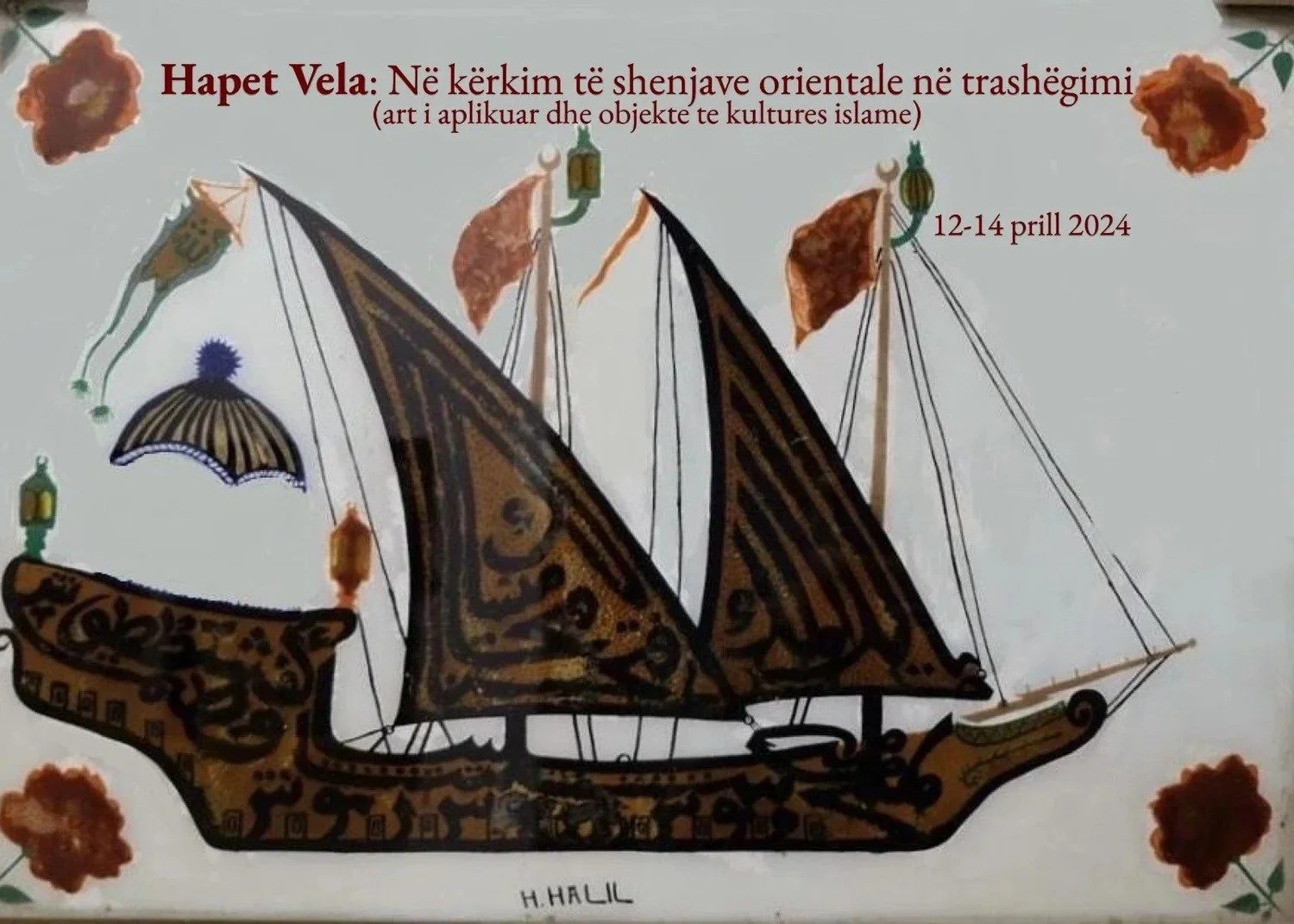
Hapet Vela (“The Sail is Unfurled”), hosted at Kalo Gallery and curated by Ervin Hatibi and Lauresha Basha, unfolded as a visual and intellectual meditation on memory, suppression, and renewal. Drawing inspiration from the Qurʾānic and late antique narrative of the Seven Sleepers of Ephesus, the exhibition invoked the metaphor of dormancy rather than disappearance: traditions may be silenced, but they are not extinguished.
In the Albanian context, this metaphor carried particular historical weight. During the communist period, religious expression was not merely discouraged but systematically eradicated from public life. Manuscripts were hidden, devotional objects removed from circulation, and artistic traditions interrupted. Hapet Vela positioned these suppressed inheritances not as relics of a closed past, but as living continuities capable of re entering public consciousness.
The exhibition featured manuscripts, calligraphy, and religious artifacts that testified to the depth and sophistication of Albania’s Islamic intellectual and aesthetic heritage. These works reflected a cultivated manuscript culture shaped by Ottoman scholarly networks, refined traditions of Qurʾānic calligraphy, and devotional arts embedded within everyday religious life. Their display challenged the long standing narrative that reduced Islamic heritage to marginal or foreign influence, instead presenting it as integral to the country’s historical fabric.
Significantly, many of the exhibited items form part of the growing collection envisioned for the future Museum of Islamic Art, a flagship project of the Konak Institute. This marked the first public presentation of selected pieces from that emerging collection, offering a preliminary view of the intellectual and curatorial direction of the proposed institution. The works spanned genres and materials, from handwritten codices and calligraphic panels to devotional objects and elements of visual culture, demonstrating the breadth of artistic production that the museum seeks to preserve and interpret.
The exhibition attracted a diverse audience, including artists, diplomats, scholars, and students, fostering dialogue across cultural and professional communities. Beyond its aesthetic dimension, Hapet Vela functioned as an act of cultural reclamation. It reopened questions of spiritual identity and historical continuity, suggesting that what once appeared dormant can, like a sail unfurled, once again gather wind and direction.
Prof. Tim Winter Book Tour Part 3 (Macedonia)
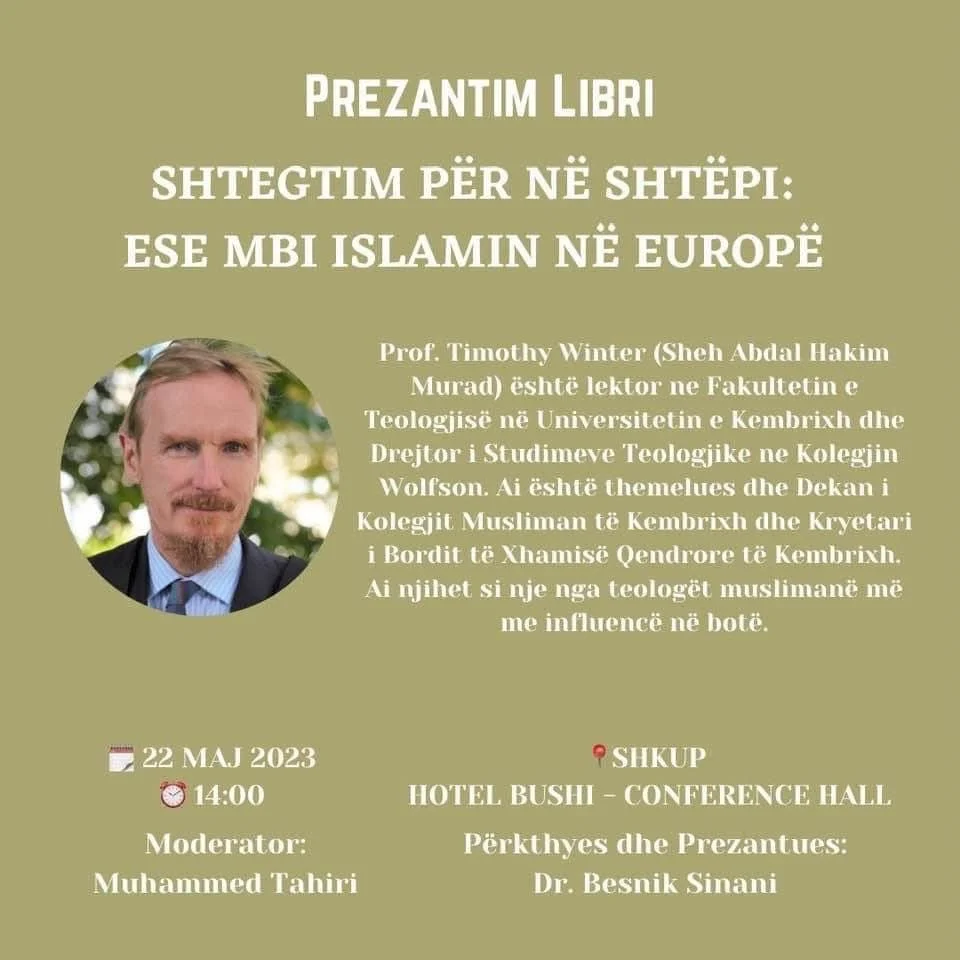
The Konak Institute had the privilege of hosting Timothy Winter (Abdal Hakim Murad), a distinguished scholar of Islamic studies at the University of Cambridge and one of the most influential Muslim intellectual voices in contemporary Europe. Trained in both the classical Islamic sciences and Western academic theology, Professor Winter’s work is characterized by a rare synthesis of traditional scholarship, spiritual depth, and philosophical literacy. His writings have consistently addressed the question of Muslim belonging in Europe not as a sociological problem, but as a theological and civilizational inquiry grounded in the resources of the Islamic intellectual tradition itself.
The publication and presentation of Traveling Home: Essays on Islam in Europe marked a significant moment within this broader intellectual project. The volume brings together a series of essays that explore Islam’s place in modern Europe through themes such as identity, secularism, reform, pluralism, and the moral imagination of the tradition. Rather than framing European Islam in defensive or apologetic terms, Winter articulates a confident and deeply rooted vision in which Muslims are understood as organic participants in the European story. Drawing upon kalām, Sufism, legal theory, and the ethical legacy of the Prophet, the book challenges reductionist narratives that confine Islam to either cultural nostalgia or political reaction.
For Muslim readers, particularly in regions navigating post secular, post communist, and post migration realities, Traveling Home functions as both diagnosis and orientation. It addresses the existential tension many experience between inherited religious identity and contemporary civic life, proposing instead a theology of presence that affirms intellectual engagement, moral responsibility, and spiritual refinement. Winter’s central argument is not that Muslims must assimilate into Europe, nor withdraw from it, but that they can recognize Europe as a legitimate arena for the unfolding of Islamic ethical and spiritual life.
In premiering and platforming this work, the Konak Institute sought to foreground a body of literature that moves beyond reactive discourse and toward constructive intellectual formation. The significance of engaging Winter’s scholarship to an Albanian readership lies precisely in its capacity to reframe questions of belonging, citizenship, and faith within a robust theological grammar. By engaging his work in public conversation, the Institute contributed to a broader effort to cultivate a generation of Muslims equipped not only with inherited devotion, but with conceptual tools adequate to the complexities of the contemporary world.
Prof. Tim Winter Book Tour Part 2 (Kosovo)
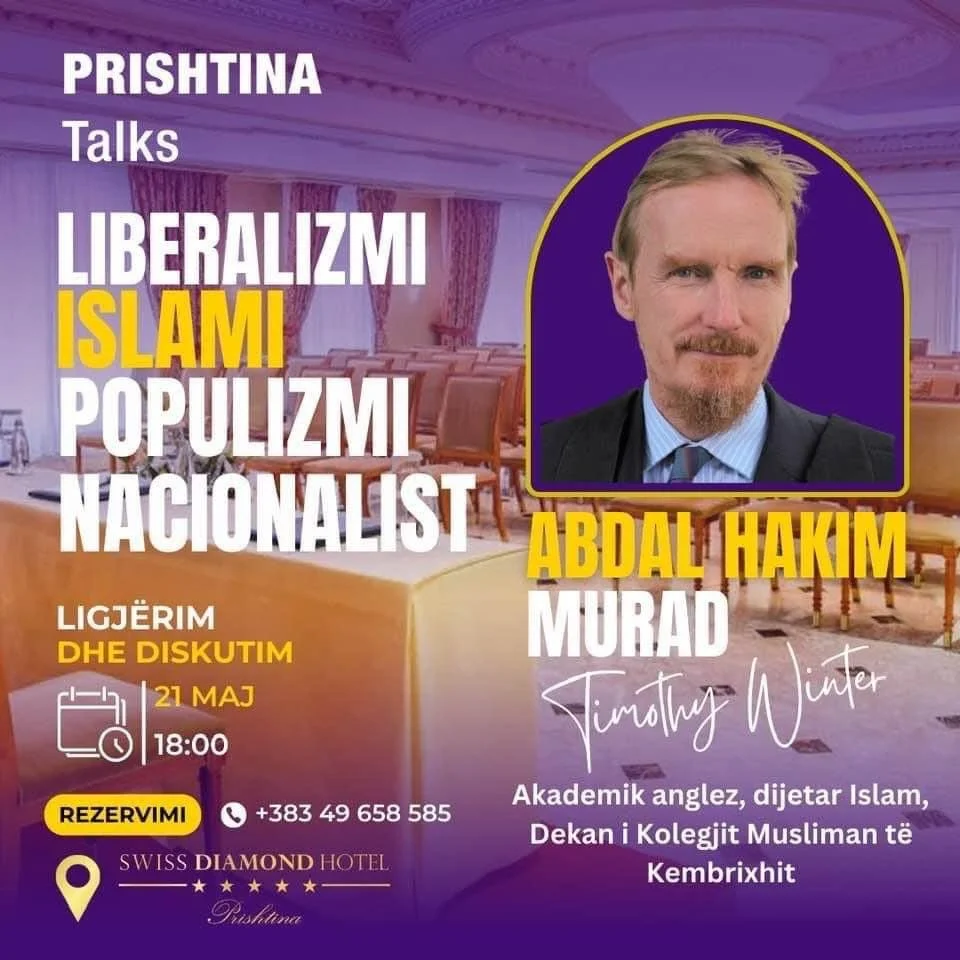
The Konak Institute had the privilege of hosting Timothy Winter (Abdal Hakim Murad), a distinguished scholar of Islamic studies at the University of Cambridge and one of the most influential Muslim intellectual voices in contemporary Europe. Trained in both the classical Islamic sciences and Western academic theology, Professor Winter’s work is characterized by a rare synthesis of traditional scholarship, spiritual depth, and philosophical literacy. His writings have consistently addressed the question of Muslim belonging in Europe not as a sociological problem, but as a theological and civilizational inquiry grounded in the resources of the Islamic intellectual tradition itself.
The publication and presentation of Traveling Home: Essays on Islam in Europe marked a significant moment within this broader intellectual project. The volume brings together a series of essays that explore Islam’s place in modern Europe through themes such as identity, secularism, reform, pluralism, and the moral imagination of the tradition. Rather than framing European Islam in defensive or apologetic terms, Winter articulates a confident and deeply rooted vision in which Muslims are understood as organic participants in the European story. Drawing upon kalām, Sufism, legal theory, and the ethical legacy of the Prophet, the book challenges reductionist narratives that confine Islam to either cultural nostalgia or political reaction.
For Muslim readers, particularly in regions navigating post secular, post communist, and post migration realities, Traveling Home functions as both diagnosis and orientation. It addresses the existential tension many experience between inherited religious identity and contemporary civic life, proposing instead a theology of presence that affirms intellectual engagement, moral responsibility, and spiritual refinement. Winter’s central argument is not that Muslims must assimilate into Europe, nor withdraw from it, but that they can recognize Europe as a legitimate arena for the unfolding of Islamic ethical and spiritual life.
In premiering and platforming this work, the Konak Institute sought to foreground a body of literature that moves beyond reactive discourse and toward constructive intellectual formation. The significance of engaging Winter’s scholarship to an Albanian readership lies precisely in its capacity to reframe questions of belonging, citizenship, and faith within a robust theological grammar. By engaging his work in public conversation, the Institute contributed to a broader effort to cultivate a generation of Muslims equipped not only with inherited devotion, but with conceptual tools adequate to the complexities of the contemporary world.
Prof. Tim Winter Book Tour Part 1 (Albania)
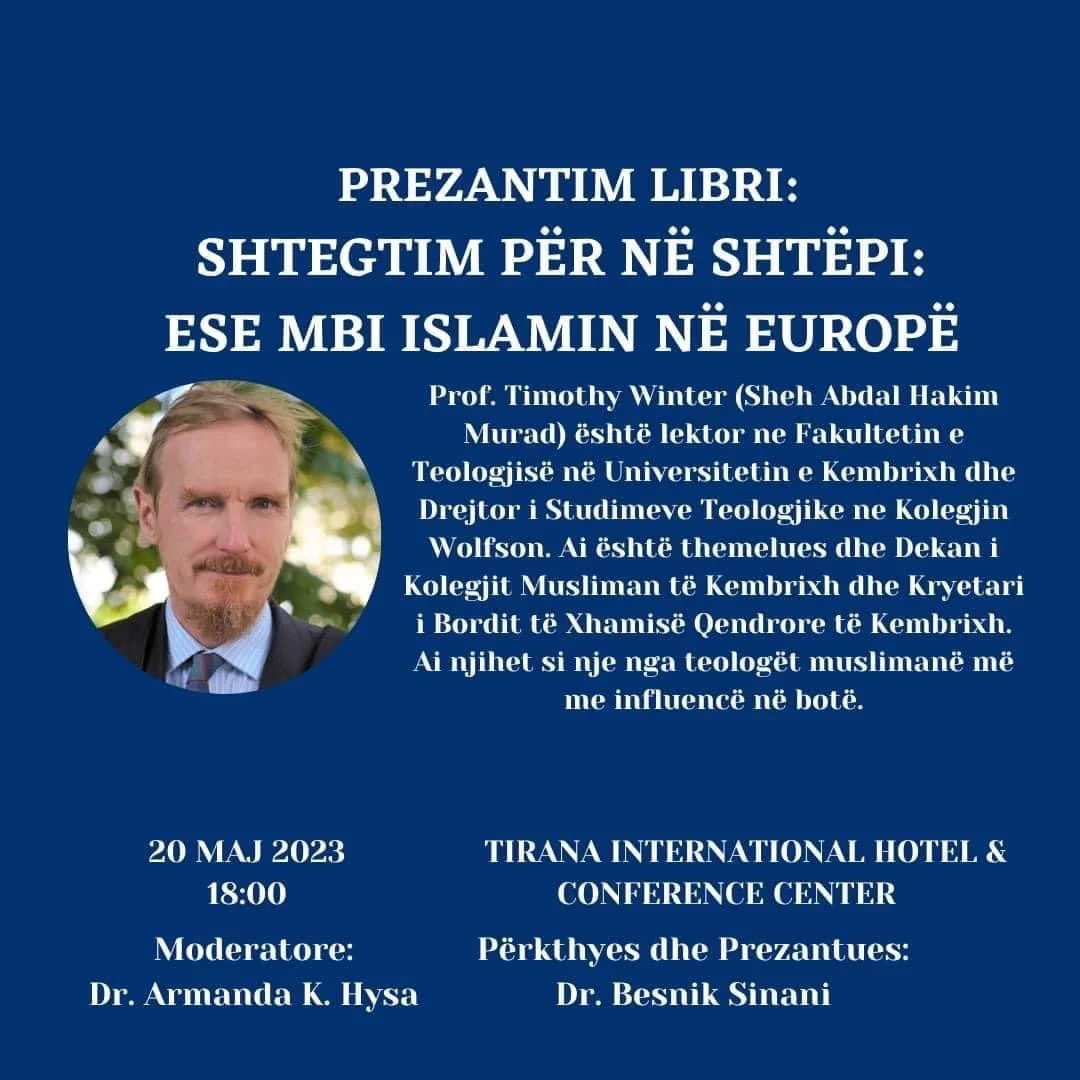
The Konak Institute had the privilege of hosting Timothy Winter (Abdal Hakim Murad), a distinguished scholar of Islamic studies at the University of Cambridge and one of the most influential Muslim intellectual voices in contemporary Europe. Trained in both the classical Islamic sciences and Western academic theology, Professor Winter’s work is characterized by a rare synthesis of traditional scholarship, spiritual depth, and philosophical literacy. His writings have consistently addressed the question of Muslim belonging in Europe not as a sociological problem, but as a theological and civilizational inquiry grounded in the resources of the Islamic intellectual tradition itself.
The publication and presentation of Traveling Home: Essays on Islam in Europe marked a significant moment within this broader intellectual project. The volume brings together a series of essays that explore Islam’s place in modern Europe through themes such as identity, secularism, reform, pluralism, and the moral imagination of the tradition. Rather than framing European Islam in defensive or apologetic terms, Winter articulates a confident and deeply rooted vision in which Muslims are understood as organic participants in the European story. Drawing upon kalām, Sufism, legal theory, and the ethical legacy of the Prophet, the book challenges reductionist narratives that confine Islam to either cultural nostalgia or political reaction.
For Muslim readers, particularly in regions navigating post secular, post communist, and post migration realities, Traveling Home functions as both diagnosis and orientation. It addresses the existential tension many experience between inherited religious identity and contemporary civic life, proposing instead a theology of presence that affirms intellectual engagement, moral responsibility, and spiritual refinement. Winter’s central argument is not that Muslims must assimilate into Europe, nor withdraw from it, but that they can recognize Europe as a legitimate arena for the unfolding of Islamic ethical and spiritual life.
In premiering and platforming this work, the Konak Institute sought to foreground a body of literature that moves beyond reactive discourse and toward constructive intellectual formation. The significance of engaging Winter’s scholarship to an Albanian readership lies precisely in its capacity to reframe questions of belonging, citizenship, and faith within a robust theological grammar. By engaging his work in public conversation, the Institute contributed to a broader effort to cultivate a generation of Muslims equipped not only with inherited devotion, but with conceptual tools adequate to the complexities of the contemporary world.